



AI is doing your next photo shoot. Right?
AI-generated images can ruin your brand.
I know this is a bold claim for 2026—when it feels like every other brand is running all its content through Midjourney or Claude, and everyone acts as if real photography is a relic from the 2010s. But I’ve been looking at the latest studies on this over the past few weeks, and anyone who takes their brand identity seriously should be aware of what they reveal.
Spoiler: The quality of AI-generated images isn't the problem. The problem is much bigger than that. 🔥

First, the good news for all AI fans: The technology has advanced to the point where most people simply can't tell AI-generated photos from real ones anymore.
A Clutch study from early 2026 tested this— 57% of respondents couldn’t tell what was real and what wasn’t. And Conjointly conducted a similar study in 2025 with an even more striking result: recognition accuracy is now at random levels. Only 9% were able to correctly identify more than 70% of the images. So you might as well just flip a coin.
Does that mean AI-generated images are okay for your branding? Nope.
Because now comes the part that most people skip: What happens if your audience DOES notice—or even just suspects?
Getty Images surveyed over 30,000 people in 25 countries on this topic. 90% want to know if an image was created using AI. And 98% say that authentic images are crucial to their trust in a brand. Ninety-eight percent. That’s not just some niche group—it’s basically everyone.
Real Talk: With AI-generated images, you’re building on a foundation that works—as long as no one looks too closely. But as soon as someone asks, “Is this even real?” you’ve got a credibility problem that no Photoshop filter in the world can fix.
And the big brands are showing us exactly what that looks like, right now.
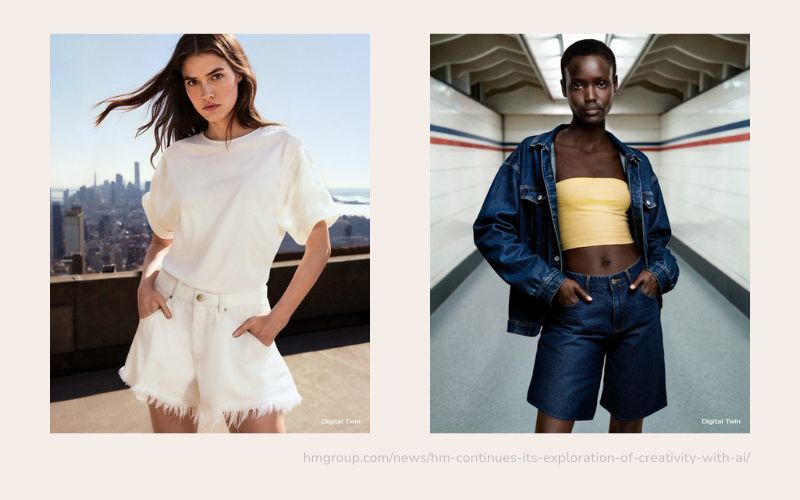
In 2025, H&M announced plans to create so-called "digital twins" of 30 models—AI-generated clones intended to replace real photo shoots. The backlash came before the first campaign even went live.
Photographers, creative unions, consumers—all at once. Comments under Instagram posts like "Boycotting H&M for using AI models—use REAL HUMANS." And these aren't isolated cases, but appear in droves.
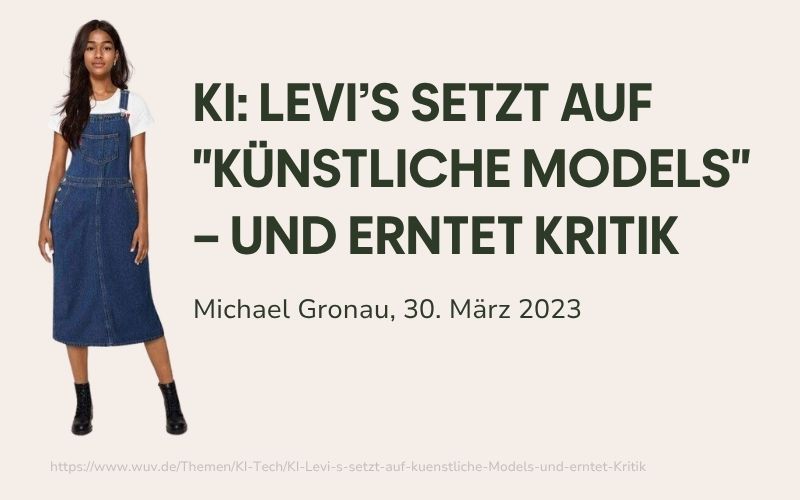
Levi's had already tried this back in 2023—using AI models, officially to "promote greater diversity." The result was a backlash, because people immediately realized that there's a difference between putting real people with real stories in front of the camera and asking a computer to generate diverse body types.
One is a matter of principle. The other is a shortcut masquerading as a matter of principle.
It sounds obvious. And yet, more and more brands are doing exactly that.
Now you might say, "Okay, but as long as people don't notice, everything's fine."
It isn't. Because the issue goes deeper than "AI or no AI"—it's about the psychological impact on your brand.
A study published in the MDPI Journal in October 2025 measured exactly that: as soon as consumers know that an image is AI-generated, they rate human-created images significantly more positively. This isn’t just a gut feeling; it’s statistically measurable. And the Journal of Marketing & Social Research showed in November 2025 that AI influencers significantly reduce perceived authenticity and trust in brands—in direct comparison with real people.
In other words: Your AI-generated image may be technically perfect, yet it still inspires less trust than a photo taken by a human with a camera. That’s because people seem to sense when something isn’t real—even if they can’t put their finger on it. And that feeling directly affects how your brand is perceived.
Gartner confirms this for e-commerce: 54% of shoppers are concerned that AI-generated images misrepresent product quality. This means that more than half of your potential customers approach your product images with skepticism before they’ve even scrolled down.
Before anyone thinks I’m completely against AI—I’m not. That would be nonsense.
The Clutch study also asked where consumers find AI-generated images acceptable. 47% are okay with AI in fictional or fantasy scenarios. 44% are okay with it in illustrations and concept art. 40% are okay with it in situations that would be too dangerous or impractical for real photography.
So yes: mood boards, concept visualizations, internal processes—go for it.
But the closer the image is supposed to be to reality, the more critical people become. Only 27% find AI acceptable in existing products. And 18% say brands should never use AI-generated photos at all.

And here’s the nuance that’s usually missing from the whole AI debate: It depends on what kind of brand you’re building.
If you have a product that’s primarily sold on price—affordable, functional, and quick to ship—then AI-generated images probably aren’t a deal-breaker.
Your customers buy because it’s €9.99 instead of €14.99, not because of your brand story. For an Amazon listing with 200 SKUs, where quick visibility is what matters? AI saves you money, and honestly, no one’s going to give it a second glance anyway.
But what if you’re building a premium brand? What if your product is sold on the basis of quality, trust, and brand recognition? What if you want to build a real community where people identify with your brand? Then every image is a promise.
And an AI-generated promise feels different from one backed by a real photo shoot, real people, and real decisions.
That’s the point most discussions about AI overlook: It’s not about “AI or no AI.” It’s about what your brand strategy is. What you want to stand for. And whether what your audience sees aligns with that—or whether it eventually becomes clear that behind the facade lies a prompt rather than a genuine stance.
WHY ALL OF THIS MATTERS:
And of course, this topic is evolving rapidly.
What holds true today may look different in 12 months. Models will improve, attitudes will shift, and tools will become more seamless.
Perhaps in two years’ time, there will be AI-generated images that even professionals can’t tell apart—and perhaps consumers’ perceptions will shift as well.
That’s why it’s worth keeping a close eye on this issue and making decisions based on data rather than gut instinct.
The studies I cited today provide a snapshot of the situation in late 2025 and early 2026. But especially with a topic that evolves so rapidly, it’s important to keep a close eye on it regularly, rather than forming an opinion once and sticking to it for the next five years.
But one thing that won’t change is this: people want to trust authentic brands. The tools may change, but that need will remain the same.

MY 2 CENTS
The whole AI debate always revolves around efficiency: faster, cheaper, more scalable. That’s all true. But branding has never been about efficiency. Branding is about trust—and you don’t build trust with the cheapest tool, but with the most honest one.
So if you're thinking about replacing your next photo shoot with AI, ask yourself this: Would you tell your client to their face that the photo was taken by a computer?
Stay bullish 🔥
Chantalle
P.S. – If you want authentic photos for your brand that not only look great but also build trust, drop me a line. We handle both the photo shoot and branding—all under one roof. 🤙🏼 ✉️ chantalle@boredbrands.studio
