


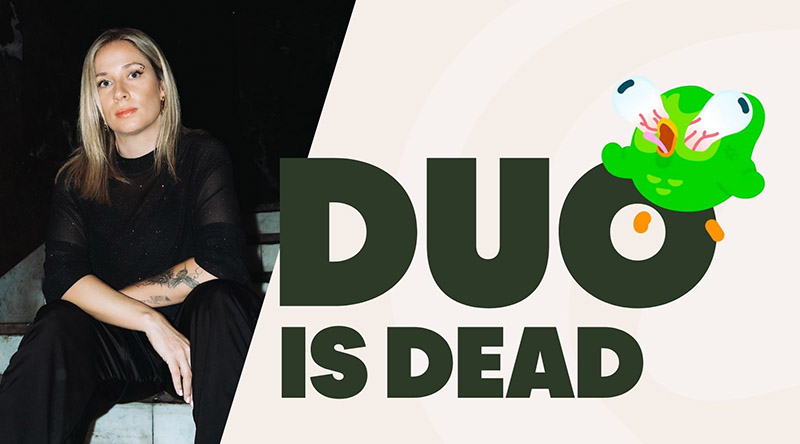
Duolingo has killed off its mascot.
On February 11, 2025, Duo was dead.
The green owl with the X-shaped eyes was lying there, tongue hanging out—run over by a Cybertruck. Duolingo has killed off its own star mascot. On Instagram, TikTok, X. Everywhere at once.
And the world has completely lost its mind. 🔥
Sounds like the dumbest marketing move ever, right? It wasn't. It was one of the smartest in a long time.
And today, I’m going to break down for you WHY this worked—and what you, as a brand, can take away from it.

First of all: What actually happened?
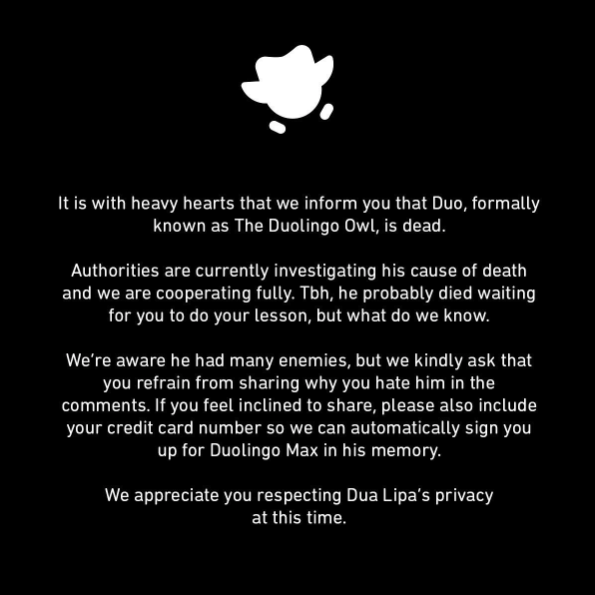
On February 11, Duolingo announced on all its social media channels that Duo had died. No joke, no disclaimer, no wink. Just: dead.
In the days that followed, videos were released showing Duo’s mascot friends carrying the coffin. Then came a clip showing Duo getting hit by a Cybertruck. And then Duolingo went and killed off the rest of the characters—with increasingly absurd causes of death.
CEO Luis von Ahn delivered a "eulogy" and urged everyone to do what Duo would have wanted: open the app and take lessons.
Two weeks later? The duo rises from the coffin. Caption: "Legends never die."
Yes. They really went all out with their mascot's death. And ended up with the most viral brand campaign of the year.
The numbers behind it—and they're wild:
1.7 billion organic impressions. In two weeks.
Just the obituary post on Instagram: 2.1 million likes and 623,000 shares.
On the day of the announcement, mentions of Duolingo surged by 25,560 percent. Prior to that, there had been an average of 11,000 mentions per day. Afterward, the number rose to nearly 60,000.
450 press reports worldwide, 60 percent of which appeared in top media outlets. NPR, local TV stations, and John Oliver covered it.
And now for the comparison: The campaign ran right after the Super Bowl. During that time, Duolingo was mentioned more often on social media than any single Super Bowl ad. Doritos, the most successful ad of the night? 57,200 mentions. Duolingo? 168,000.
Why this worked—and why it wouldn't work for 99% of brands:
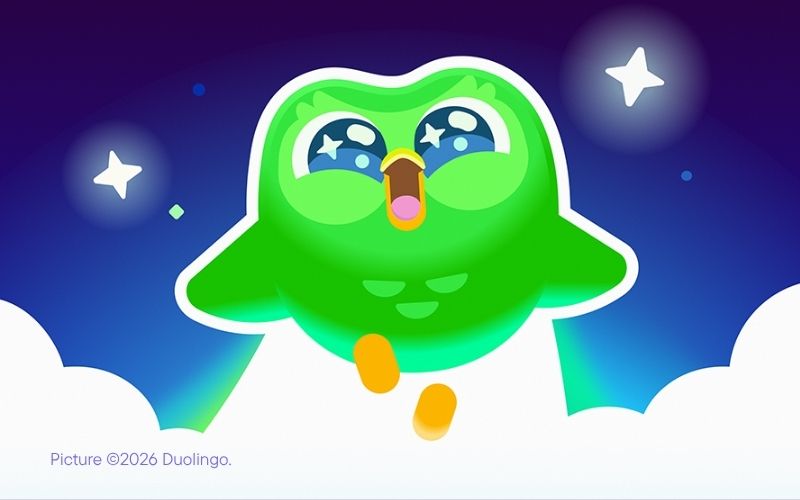
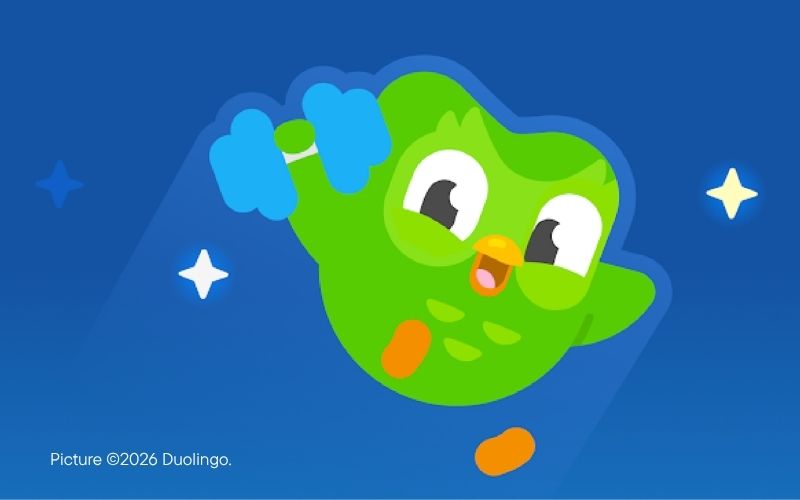
Duolingo was able to kill off Duo because Duo isn't a logo. Duo is a character.
For years, the owl has had its own distinct personality on social media: cheeky, obsessive, slightly unhinged. Duo threatens you if you don’t do your homework. Duo guilt-trips you via push notifications. Duo stalks Dua Lipa—a running gag since 2021 that went so far as to include a fake marriage proposal before a concert.
Nearly 17 million TikTok followers (as of 2025) didn't come for a language-learning app. They came for a character who feels like a real person.
And that's the point:
You can only "kill" something that means something to people.
Duo means something to people. That’s because Duolingo has invested years—not in ads, but in a character with humor and consistency.
The real stroke of genius: gamification meets emotion
Duolingo didn't just create content. They integrated the campaign into the product.
To "revive" Duo, users around the world had to collect a total of 50 billion XP. And you only earn XP by completing a lesson. So, half the world opened Duolingo—not for an ad, but to save an owl.
The result? 50.9 billion XP. Across more than 15 countries. That’s roughly 5 billion completed lessons. In just a few weeks.
Q1 2025 was Duolingo’s strongest quarter ever in terms of new and reactivated users. Revenue rose by 38 percent in the same quarter, and in 2025, Duolingo surpassed the $1 billion mark in annual revenue for the first time.
Psychologists call this underlying principle "loss aversion"—we are more motivated by the fear of losing something than by the prospect of gaining something. Duolingo has been using this for years through streaks and the crying owl in push notifications. With "Dead Duo," they've scaled that same principle up to an entire campaign.
And then Dua Lipa came on.
The day after the news of his death, Dua Lipa posted on X: "Til' death do us part."
Wordplay. Casual. Perfect.
Her repost alone generated 667,000 engagement actions. Her comment on the Instagram post received over 141,000 likes.
That wasn't a paid deal. It was the result of four years of character development and a running gag that was so good that one of the world's biggest pop stars agreed to be part of it.
That’s earned media at a level you can’t buy. You have to earn it.

What this means for YOUR brand:
You don't have to kill your logo right now. Please don't. 😅
But here are the real takeaways:
First of all: A mascot isn’t just a decorative addition to your logo. It’s a strategic brand asset. When you give a character a real personality—cheeky, brave, independent—it builds a connection that no advertising banner in the world can match. People don’t love apps. People love characters.
Second: Consistency trumps creativity. Duo is on TikTok, Instagram, X, and in push notifications—maintaining the same personality everywhere. Always. That’s no accident; it’s a strategy. And that’s exactly what makes it recognizable at every touchpoint.
Third: Courage pays off. Duolingo’s CEO pushed the team with the words: “Make it fun. Make it weird.” And when the team delivered, he said: “Make it weirder.” Most brands would tone that down by the third round of approvals. Duolingo saw it through. That’s the difference between a viral campaign and a forgotten post.
Fourth: Tie your campaign to the product. "Dead Duo" wasn't just an awareness campaign. It got users to open the app and take lessons. Every good campaign should contribute to your core product in some way—not just to reach.
MY 2 CENTS
"Dead Duo" isn't a template you can just copy. But it's the ultimate proof that character branding works—if you're serious about it.
Most brands treat their mascot like a decoration. It looks good on the logo, it looks good on the website—and that's it.
Duolingo created a character so lifelike that his death moved millions of people. This isn't a marketing gimmick. It's branding at its finest.
The question isn't whether your brand needs a personality.
The question is: Do you have the courage to give it a real voice?
See you next week—stay bullish. 🔥
Chantalle
P.S. – If you're interested in character branding and wondering if it might work for your brand: We create characters in-house. Just drop me a line via this newsletter, and we'll chat. 🤙🏼 ✉️ chantalle@boredbrands.studio
