


Made by Humans:
The New Premium Label
Hey Brand fan,
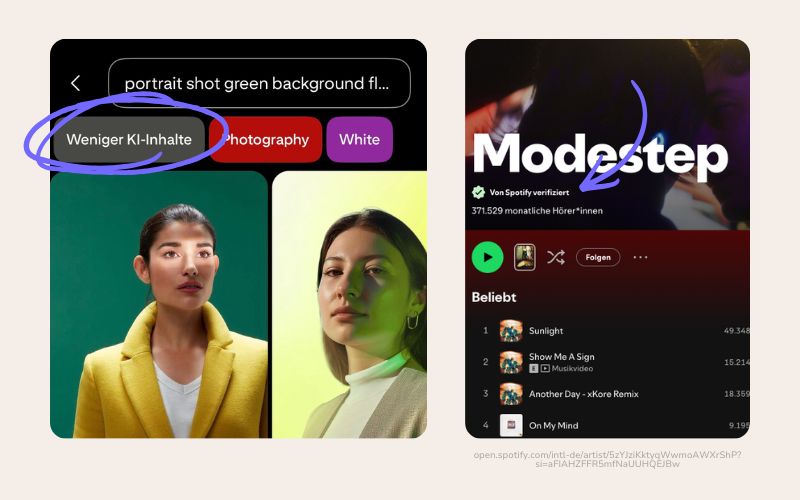
On Pinterest, you can now toggle a setting. Under "Refine your recommendations," you can tell the app that you want to see fewer AI-generated images in categories like beauty, art, or interior design. Pinterest labels the affected pins as "AI-modified" and cites studies showing that more than half of all online content is now generated by AI. Let that sink in for a moment. The internet is full of it, and the platforms are currently building tools to help you avoid this content.
And Pinterest isn't the only one.
At the end of April 2026, Spotify introduced the “Verified by Spotify” badge—a small green checkmark that indicates there’s a real person behind the music. AI personas don’t get it. And the company is stepping up its efforts: Starting in mid-September, purely AI-generated artist profiles will receive their own “AI Persona” label and will be automatically excluded from recommendations.
Then there’s the law everyone’s been talking about. Article 50 of the EU AI Act takes effect on August 2, 2026. In short: AI-generated images, videos, audio, and text must be labeled as such, and chatbots must disclose that they are bots. The proposed label here is simply “AI.” Anyone who ignores it risks a fine of up to 15 million euros or 3% of their global annual revenue. It doesn’t apply to simple processing like spell-checking, and there’s a grace period for existing content. But the direction is clear.
Within just a few months, “made by humans” has gone from being a claim to something that must be proven.

And now comes the part that really interests me as a designer and photographer. Because this isn't just about pictures.
This runs through your entire branding—your copy, your campaign concept, your design, and how you interact with customers through support. From now on, the same unspoken question hangs over everything: human or machine? And your target audience is now answering that question quite clearly.
A Gartner survey of 1,539 U.S. consumers (March 2026) showed that half would prefer to buy from brands that do not use generative AI in their external communications. This is not a marginal group. It’s half.
And now let's get down to the specifics of the account:
- According to eMarketer (2026), 73% of shoppers feel less confident about buying a product if they suspect that the main image was generated by AI.
- And a Statista analysis (2026) found that 58% of retailers who switched entirely to synthetic product images saw a year-over-year decline in their conversion rate.
That's what I like to share with my clients the most. A professional photo shoot will cost you more up front than a stack of quickly generated AI images—that's for sure.
But going with the cheap option could end up costing you the sale. The premium status isn't just a decorative add-on. It protects the very thing that earns you your money: the confidence that behind your brand image is someone who knows what they're doing.
My two cents, and just so we're clear:
I have absolutely nothing against AI. We use it ourselves. For certain graphics for clients—when it’s appropriate and requested—AI is exactly the right tool. I’m a designer and photographer; I don’t condemn any technology that makes my work easier or improves the results when used in the right way.
The difference lies in where you use it. AI in your workflow is a win. AI as a substitute for what actually defines your brand will end up costing you dearly.
Because the things you can’t generate are precisely what become truly valuable. A real face, real light, an idea that comes from a person’s mind rather than from a prompt. That’s exactly why I continue to shoot with a Leica—real instead of calculated—and for me, that difference isn’t just some retro gimmick.
Specifically for your brand:
✅ Keep the human touch in everything that builds and drives trust: your faces, your real customers, your brand story, your voice. That’s where your target audience pays the closest attention.
✅ Use AI where it saves you time and where the results aren't visible to others: research, initial sketches, internal processes, or even graphics—wherever it makes sense and is appropriate.
✅ If AI ends up in a customer’s face, own it. The AI Act makes transparency mandatory anyway, and your target audience will reward you more for being upfront than for hiding things.
A quick reality check so things don’t get too contrived: You don’t have to slap “human-made” on every poster right now. A label like that won’t help you at all if everything’s still being generated by a computer in the background—people will see right through it in two seconds. It’s not about the sticker. It’s about there actually being someone there who you can see.
Stay bullish 🔥 Chantalle
P.S. If you're wondering whether your next project needs a real photo shoot or if AI will suffice, just send me a quick note about what you're working on. That's exactly the question we're constantly discussing at the studio. ✉️ chantalle@boredbrands.studio
