


Levi's' Marketing Stunt of the Year during the FIFA World Cup. 😮💨
Hey Brand fan,
FIFA forced Levi's to remove its name from its own stadium. And that turned out to be the best free publicity the brand has gotten this year.
When you cover up your logo, but everyone still recognizes it
A brief background: The 2026 World Cup is currently being held in the U.S., Canada, and Mexico. One of the 16 stadiums is Levi's Stadium in Santa Clara, which has been named after the denim brand since 2014 and is home to the San Francisco 49ers.
FIFA has a rule called the “clean stadium policy.” In every tournament stadium, only advertisements from official sponsors may be visible. Anyone who pays up to 100 million dollars for these sponsorship rights (according to LLLLITL, 2026) doesn’t want a jeans brand reaping the benefits for free.
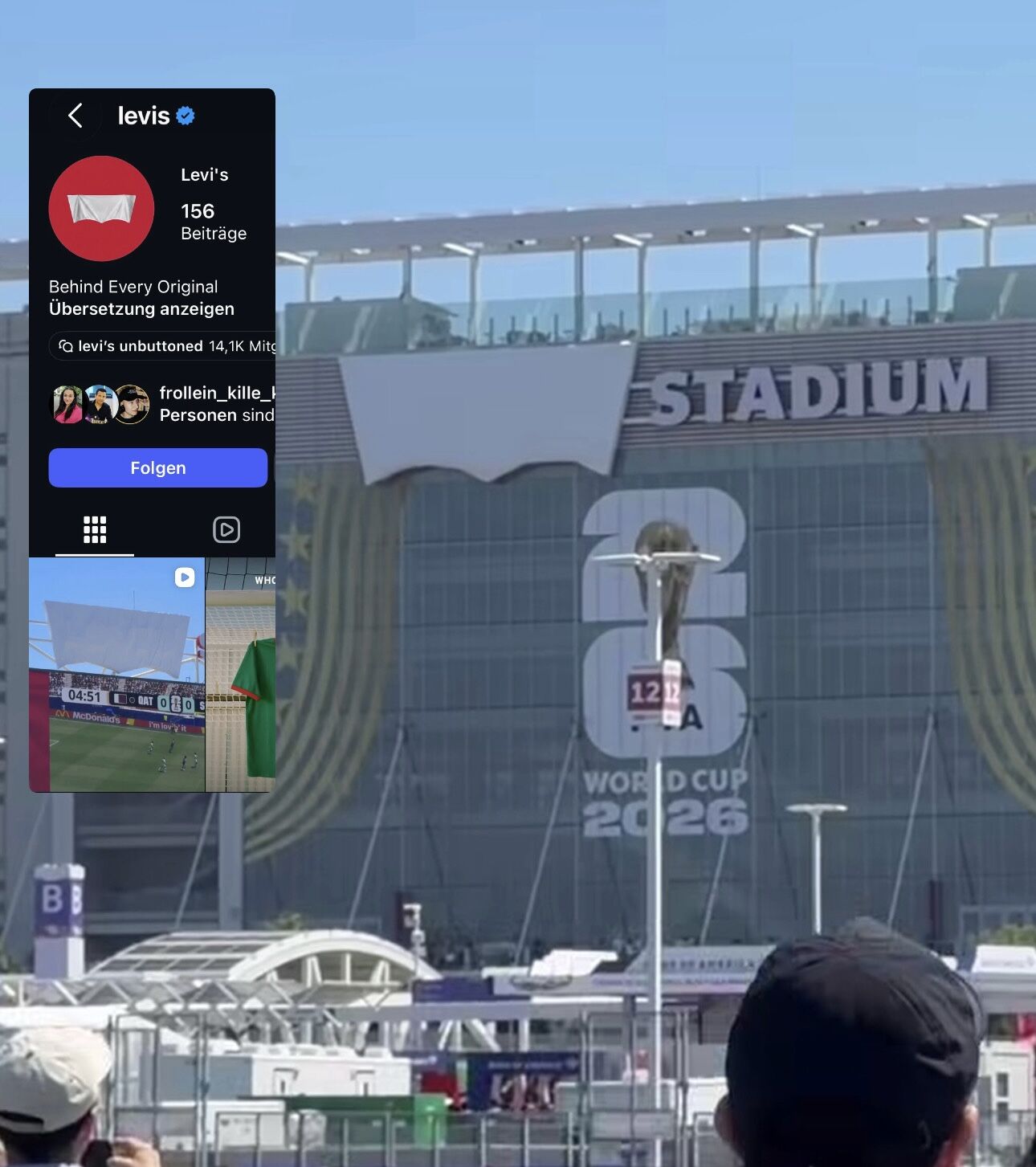
In other words: For the duration of the tournament, Levi's Stadium will become the "San Francisco Bay Area Stadium." The red batwing logo? Covered with a white tarp.
Levi's isn't alone in this. SoFi Stadium became "Los Angeles Stadium," and MetLife became "New York New Jersey Stadium" (according to Marketing-Interactive, 2026). In Houston, over $1 million has been budgeted just for removing and covering logos (according to Storyboard18, 2026). And in Atlanta, the giant Mercedes star was allowed to remain on the roof because removing it would have damaged the retractable roof structure.

Now things are getting interesting for us.
The tarp covered the name. But the shape remained. And the shape alone is enough.
The Batwing logo was designed in 1967 by Walter Landor & Associates (Source: levistrauss.com). The silhouette is no coincidence—it’s the curve of the arcuate seam on the back pocket of every pair of 501s. The same shape that has graced millions of back pockets for decades.
Marketing blogs are debating whether the tarp was deliberately cut to match the shape of the logo or simply followed its outline. It doesn't matter. The result: Even if you cover up the lettering, people still recognize Levi's. Photos of the taped-up tarp went viral, and everyone knew right away what was underneath.
That’s the definition of a strong brand asset. It works even without a name—a prime example of true brand recognition.
And now for the part that really caught my attention as someone who works in branding: how Levi's responded.
No "we regret the decision" statement. They just went along with it:
✅ Changed my Instagram profile picture —now it's the masked-out logo on a red background
✅ A post featuring the covered-up logo above the scoreboard, with the caption: "Welcoming the world to the beautiful [redacted] stadium"
✅ Here's a video related to the "Nobody's gonna know" trend
(All according to NBC Sports & Marketing-Interactive, June 2026)
The reaction in the comments? People wanted to buy T-shirts featuring the censored logo. BBC Sport picked up on the move, as did half of the marketing community on Twitter. What started as a restriction turned into an inside joke that the entire industry shared.

My 2 cents: There are two lessons here, and the second one is the more important one.
Lesson 1: A logo is strong when it no longer needs its own name. Here’s an honest question for you: if we took the text out of your logo tomorrow, would anyone still recognize you? For most brands, the answer is no. And that’s okay at first—you don’t build a brand asset like that overnight. But that’s exactly where consistent visual language, repeated year after year, leads.
Lesson 2: Levi's didn't fight the rule—it turned it into a joke. Quick, casual, and with plenty of humor instead of a press release. Most brands would have spent two days in endless coordination loops and ended up putting out a toothless statement. Levi's changed its profile picture on the very day of the event and hijacked a trend. By the way, this approach also works creatively, without any ragebait.
Reaction speed plus confidence in Brand. That's the real win.
What you’ll take away from this: You don’t need a stadium or a brand history dating back to 1853. But build a visual identity that stands on its own, even without your name tag. And if you ever run into a silly restriction, ask yourself first if you can turn it into a punchline before you start fighting it.
Stay bullish 🔥
Chantalle
P.S. If you're currently streamlining your visual system so it remains recognizable even without a name tag, that's exactly what we do every day at the studio. Just reply to this email, and I'll take a look at it with you. ✉️ chantalle@boredbrands.studio
