



The best "sub-brand" school is right in your bathroom.
Hey Brand fan,
A quick reality check: Whenever a subbrand is launched, everyone immediately starts talking about the logo, name, and colors. That’s understandable—it’s fun, after all. But the most important decision regarding brand architecture has long since been made (or overlooked) by that point: How much distance should there be from the parent brand?
Everything else follows from that. And the best master class on this is free—it's right there in your bathroom.

The dilemma:
If you stay close to the parent company, you'll earn its trust. Nice. The catch: Your brand doesn't have a face of its own, and any image problem the parent company has lands squarely on you.
If you go far away, you’ll have freedom and recognition. The catch here: You’re starting from scratch. And you’re giving away the most valuable asset your mother has built up over the years: trust.
Spoiler: There's no one-size-fits-all answer to this. The real question is: What should you bring along, and what should you absolutely not bring? Once you get that, the rest almost takes care of itself.
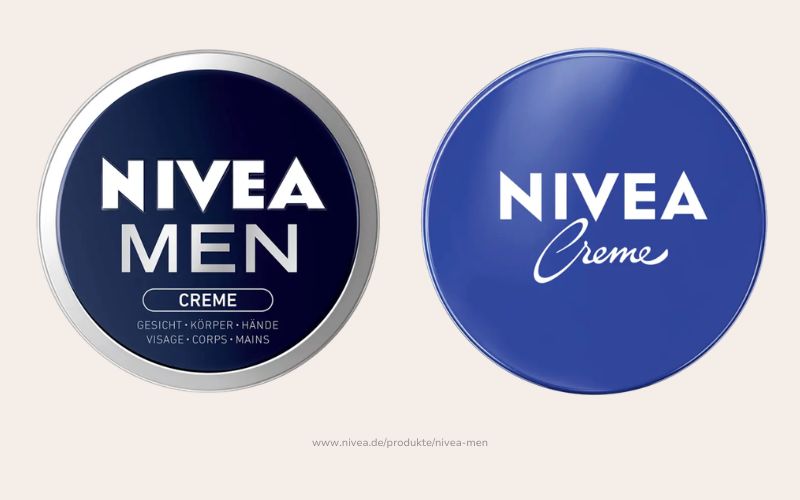
Nivea Men: Maximum Closeness, Full Intent.
Same blue, same font, same can, just one word added. And there you have it—the subbrand is ready. It sounds lazy, but it’s smart: The promise remains exactly the same (gentle, reliable care since 1911, the blue can since 1925); only the target audience is new. So all that trust carries over. Any deviation in the design here would be a waste of money.
The numbers: Launched in 1986 as “Nivea for Men,” it became the first mass-market brand to offer men’s skincare in 1993, and has been known as Nivea Men since 2012. Today, it generates over 1.1 billion euros in revenue (2021) and accounts for about 20% of Nivea’s total revenue. In a word.
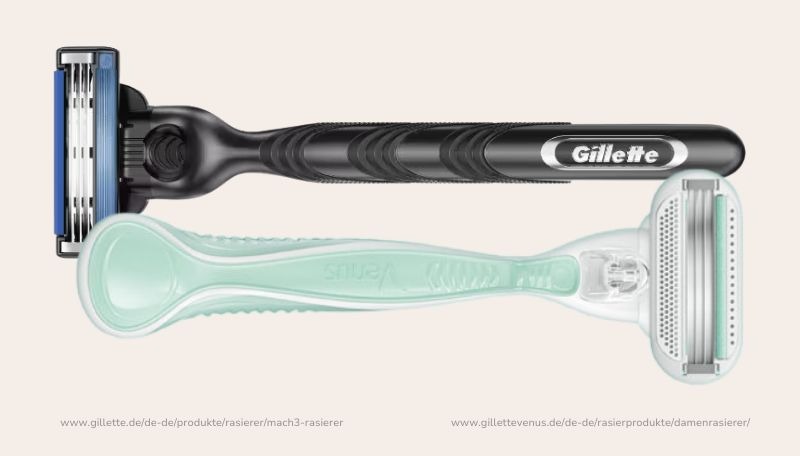
Gillette Venus: Half the distance, a different direction.
Gillette is doing the same thing in reverse—moving from a men’s brand to a women’s sub-brand. But in this case, maximum similarity would have been a disaster. “Mach3 for Women”? Men’s razors in pink packaging—no thanks. So in 2001, Venus got its own identity: its own name, its own look, its own voice. And yet “Gillette” still appears in small print on the packaging, so the blade brand’s reputation comes along for the ride.
A perfectly calculated strategy—and it paid off: a simultaneous launch in 29 countries, $150 million in marketing, and a few months later, the best-selling razor in the U.S. (2001).
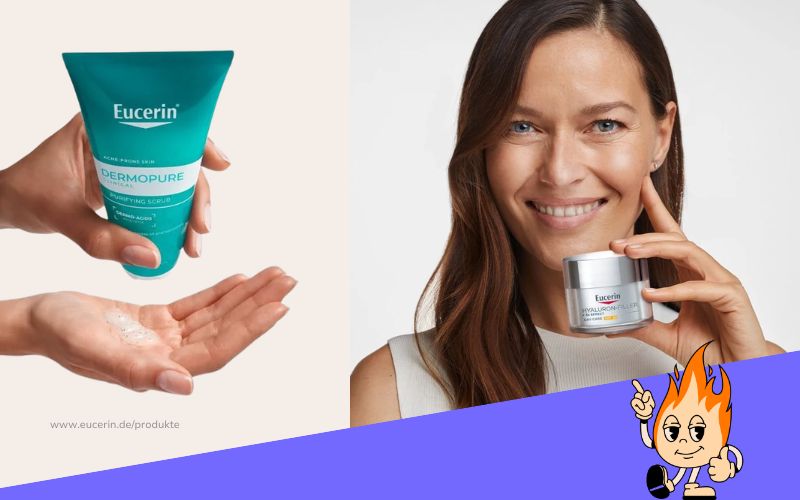
Eucerin: the whole distance. And here's the best part.
Case 3 belongs to the same corporate group as Case 1: Beiersdorf. Fun fact: Nivea and Eucerin are actually based on the same emulsifier from the same laboratory (Eucerit, patented in 1900 and purchased by Beiersdorf in 1911). And yet, you won’t find even a hint of Nivea on any Eucerin package.
Why? Eucerin relies on recommendations from pharmacies and dermatologists. Imagine that mass-market blue next to a dermatologist’s recommendation, and all that credibility goes out the window. So: a clinical look, a matter-of-fact tone, its own distribution channel, and no family photos.
It paid off: In 2024, Eucerin became the Group’s second billion-euro brand after Nivea, and the derma business posted double-digit growth for the fifth consecutive year in 2025.
My 2 cents: Before anyone creates a mood board, here are three questions.
✅ Same promise, same price point, new target audience? Stay tuned. Transferring trust is free marketing (Nivea Men).
✅ A new target audience that can't relate to the "mother world"? Take a step back: build your own world, and label the mother as a minor influence (Gillette Venus).
✅ Does the "mother" image get in the way—in terms of price or credibility? Keep a clear distance, even if it’s based on the same formula (Eucerin).
The best proof that this isn't a matter of taste: Beiersdorf is pursuing both extremes at the same time. Nivea Men is as close as possible, while Eucerin is as far away as possible. Same company, both are right. Period.
Oh, and by the way: The same goes for language. A brand’s logo and signature sound are just a facade. Venus sounds different from Gillette; Eucerin sounds like a lab, and Nivea sounds like a summer vacation. It’s all intentional.
Real Talk: You don't need a big corporation for this. The same question applies to your second line, your budget offering alongside your premium offering, or the new product you're testing under your own name. And no, you don't have to build an entire brand universe right away. Sometimes the "Venus move" is enough: your own name, a small line below it saying "a product by X"...that's it.
Stay bullish🔥
Chantalle
P.S. Are you currently planning a second brand, line, or new offering and unsure how much distance you need to keep? That’s exactly what the initial consultation is for. ✉️ chantalle@boredbrands.studio
